Friday, July 8, 2016

So your CPAP treatment isn't working?

I've gone through seven or eight sleep studies. I've lost count of exactly how many, but the last three at the same sleep lab, without my symptoms being fully improved. I would estimate that at the beginning they were about 20-30% better, but years later seemed to fail completely.

What I eventually discovered is that exercise actually made my sleep quality much worse. If this sounds like  you, it might, then it is possible we share an odd, and previously unreported condition. The only other two conditions which I've read that can cause this is Cushing's Syndrome and Chronic Fatigue.  However, sleep apnea that is not fully treated can mimic both of these, including elevated cortisol levels. So if you have noticed, or are able to determine if exercise is bad for you, then we may share a condition, which is treatable!

The problem in my case only was that I have two modes of sleeping. The lazy day, fully rested mode, and the "I've worked out" mode.

Why didn't the previous sleep studies help?

The previous sleep studies did find a partial solution.

I didn't notice the problem at the time, but looking back it seems that since I slept poorly after exercising I learned not to exercise, even a little. I stopped taking the stairs and always chose an elvator, had groceries and food delivered, anything I could do to avoid physical labor. That is, my symptoms conditioned me not to exercise, so I would go get a study done after a couple of days of being fully rested, and as a result my full symptoms did not occur. I only know this after-the-fact because of the use of a Jawbone UP (lasted 3 months, but did the job) which allowed me to discover exactly when I had good and bad days of sleep.


After using the Jawbone for several months looking for clues to my problem I was able to completely correlate exercise with poor sleep the next several nights. This is the exact opposite of what should happen for most people but for me was the wall I could not overcome.


Confounds

Moderate exercise (5,000 steps / day) would not cause this problem to occur immediately.  It would sneak up on me.  I needed it to be vigorous, or weight bearing to cause the symptoms to show up faster.

Another thing that seems to trigger this effect is calcium channel blocking medications, or medications which are related. These can be prescribed for a range of issues from depression to high blood pressure.  The good news is that if this is you then your sleep studies should show up without having to go through the exercise portion of this experiment. 

Further, the post-exercise crashes would last for days, sometimes even a week.


How can I tell if this fits me?

If you have a Jawbone, FitBit or ResMed S+ you may see your deep sleep very disturbed, or lots of wakings, despite the CPAP measuring otherwise low AHI numbers and tolerable leaks.

In the picture on the left I share an image from the Jawbone UP application showing my very worst night of sleep.  See how many different periods I have of deep and light sleep?  There should be about 8 of them.  Instead I have about 17.  Also notice the time I slept. Over 11 hours! That's because the sleep quality was so poor.

You should have big chunks, around 6-9 of deep sleep/light sleep cycles with no awakenings. 


Be Your Own Guinea Pig


If you want to investigate on your own first, try to correlate it over a couple of weekends.  One weekend take it completely easy. Do no physical labor for two days, see how well you sleep Sunday night. If weekends are your housework days, hire a cleaning service this once. If you are already in a disturbed sleep cycle though you may need to do this for several days until your symptoms clear.  Only after you are in a "good" cycle should you attempt to disturb your sleep with exercise.

The next weekend, attempt to exercise normally both days. I don't mean do your normal routine, I mean work out 30-45 minutes each day, see how much of a difference this makes to your sleep Sunday night. If you find that your first Monday was great, and your second Monday terrible, you fit this profile.  However, there are many unanswered questions that remain, and I've noticed in addition to exercise a secondary, cyclical pattern which I have yet to pin down.

Notice that the ResMed S+ was less sensitive for me than the Jawbone for this particular issue.


How can I get better?

Schedule another sleep study, but this time make sure you exercise normally the day of the study, if not two days before the study. In my case this was really a challenge, since my symptoms had been getting worse, my energy levels and moods had been suffering, causing me to exercise less and less.

It really helps to hire house keepers and have friends to support you.  Let them know what you are up to and that you'll need extra help while you try this. Take time off from work if needed. If you are like me, you'll crash for 3-5 days and be completely unproductive after the exercise portions.

It's also important to stress that immediately after exercising I felt great. My lungs felt clear, I felt light on my feet, it was such a great thing. It was only after I slept and failed to recover that symptoms appear.


Tips:

Remember that exercise IS recommended as part of almost every sleep improvement regimen, so you aren't breaking any rules by following the advice here. In all cases follow the advice of your doctors and personal trainers, but the guidelines here should be in compliance with them.

Right now as far as I know, there is no guidance on exercise before a sleep study/titration, however it's generally recommended not to exercise in the late afternoon evening as it can wake you up and prevent you from sleeping fully. 

The day before the sleep study:
  • Have no alcohol.  Zero.
  • Stop caffeine and chocolate after noon. 
  • Have a couple of bananas.  
The bananas and stretching do nothing for sleep, they are to help prevent leg cramps, skewing your study, and possibly disconnecting your wires. If you aren't used to exercising, a little extra potassium will help.  Any other potassium-rich food will do of course, if you are allergic, or just don't like them.

The day of the sleep study:
  • Have no alcohol, Zero, nada, zilch. 
  • Exercise as much as you should be able to do if you had no sleep issues.
  • Exercise vigorously 30-45 minutes in the morning if possible, but no later than early afternoon. Get into your aerobic zone for most of it. Again, be an adult and follow the advice of your doctors and qualified exercise instructors. For me, it seems that weight bearing causes the symptoms faster than aerobic exercise, so a few squats to tire your legs out may be all you need. Climb stairs with a couple of gallons of water in each hand should do the trick as well if a gym is out of your reach.
  • Make sure to cool down and stretch your legs.
  • Have a couple of bananas after your workout.
You may be desperate for an answer, but if you are like me, this doesn't take THAT much effort to tip your body over, so don't give yourself a heart attack before your sleep lab!

In my case, it was like magic, symptoms that had never shown up before became clearly and consistently visible during the lab work. The CPAP machine that was fine for the first 6 studies was completely inadequate now.


By challenging your body, and your CPAP machine you'll have the best study possible.

If you are a sleep specialist, or researcher, and would like detailed information I would be willing to make that available privately.  Please leave me a comment with information about your publicly visible contact information and I'll reach out to you.

Wednesday, June 22, 2016

Magico S1 Mk II - The measurements

Sound Stage Network released their own measurements and had the chance to evaluate the S1 Mk II for a longer period of time than I have.

It's time for a closer look and to see where I was right, and where I was wrong. Hans Wetzel's review was overwhelmingly positive, while mine was positive with nuances.


Tonality

Honestly, I hate the word "tonality." Is it even a word? So many have heard the S1's and proclaimed them to have "spot-on tonality" to my surprise. I didn't think so, but hey, let's see what the measurements say.

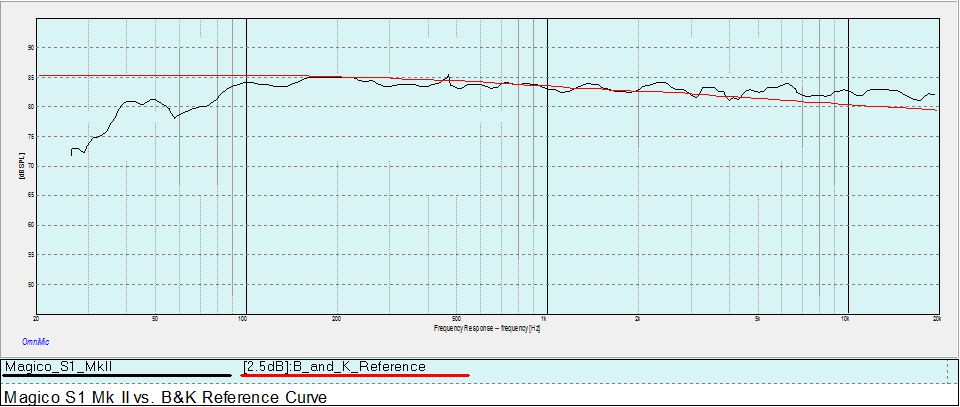
First, remember I said it was bright, with excess energy around the bottom of male voices?  Well, based on my reference speaker curve from Bruel and Kjaer, I was right.

Take a look here, we compare the two.


At least from my own reference perspective, I was spot on. The treble runs a little high for me, and the peak energy is around 200 Hz, a little over an octave higher than I would like.  I was also right about the treble being very smooth and unblemished (more on that in the next chart). I was wrong about the overall balance being smile-shaped though. This is in fact pretty flat, just not necessarily going exactly where I'd like, but that can be adjusted for with reduced toe-in or DSP. When I listened to these speakers it was practically on axis.

In the end there's really no cheating physics and there is only so much you can do with a small driver but I am really surprised the energy falls off that soon, it does sound better than that, but this early bass peak does explain why I though the mid bass was a little too much.  At the same time, that early drop off is going to give a sense of exaggerated bass clarity, since you won't activate troublesome room modes below 100Hz as much as with a true full-range speaker. 


Compression

One measurement I was surprised by was the amount of compression between 70 dB and 90 dB.  That is, at higher volume levels the top treble will stand out more due to compression in the mid-treble.  It is going to be really important to evaluate these speakers at the right volumes for you.  If you listen at low volumes, listen to them that way, and vice-versa.  This undoubtedly contributed to my impression the speaker was smile-shaped.  At 90 dB, it starts to go that way.

Based on the early bass drop off I would try to keep the speakers within 2 feet of the rear wall, but far far from the sides to get a little bit more bass without compromising the imaging and clarity of those wide dispersion tweeters.


Comparing the S1 to the B&W 802 D3

Let's do another graphing trick.  Let's compare Stereophile's measurements of the B&W 802 D3 to the S1 measurements from the NRC of Canada. There are many reasons to be critical of this chart, as the measurement methods are undoubtedly different and I never had access to the raw data.  Still, I think it's worth using as a rough guide to what we could expect, and at least one dimension of how these two speakers could be alike, or different:


Notice the Stereophile Curve is in play with the B&W. See the dip at 2.4 kHz and the peaks at 4kHz and 10 kHz? Not a neutral speaker at all.  The Magico S1 is in fact much closer to neutral, without any gimmicks applied. Of course, the B&W has more bass, and about 7 dB more sensitivity, among many other differences. This technique is fun to play with and as long as lives are not at stake, worth showing.


The Impedance Curve

What about the minimum impedance? I was wrong to worry too much about it going too low. In fact, the impedance measured by Sound Stage is very good, reaching a minimum of around 3.6 to 3.8 Ohms at 150 Hz with a near 0 phase angle.  Quite benign for most modern amplifiers.  Further, that same impedance chart is evidence of a simple, no-nonsense crossover based on well meshing drivers. Fabulous!


The Amplifier

That being said, I was not wrong about these speakers needing a beefy amp. Take a look at the 1 kHz sensitivity. 82 dB?? Wow, that really is pretty low.  In fact I can't remember the last time I saw a 2-way design with such a low sensitivity rating.  The S1 Mk II's will in fact need a big amp to sound loud.

So is this worth $16,000? I think it's a pretty nice speaker, with my objections noted. Listen for yourself. With proper toe-in (as in none) and a subwoofer to support them, and space, lots of space, the S1's are pretty nice.  Whether you find the compression or limited bass objectionable or delightful however is going to be entirely up to you.

Last, unlike some other mid-price speakers introduced this year, they are unlikely to melt in the rain.  Bam! Hahahaha.


Poor Music Lover's Alternative

If $16,000 for a two-way, limited bass speaker pair is never going to be realistic let me suggest three very good sounding kits you can build from $500 to $3,000 on my other blog, here.

Tuesday, June 7, 2016

The LM-1 vs. My Laundry

As a side effect of the movers taking most of my furniture, I had to move the LM-1s off their stands 2 feet from the rear wall to half that distance, sitting on books on the TV stand.

In this location I find them too boomy. What's the solution? Socks. I put a big clean fluffy white sock to plug the port in the back of each. Problem solved!  They don't sound as good as they did further away, and further apart, but they have regained their tonal composure.

Sunday, June 5, 2016

The LM-1 vs. Your Chair

Quick setup instructions.

A number of readers have asked me about the horizontal layout of the drivers. I was just being creative with the pictures, but I personally listen to the LM-1's with the traditional tweeter-over-woofer, "portrait mode" arrangement.  Of course, you can lie them down to fit tight spaces, or to keep a lower profile over a mixing console, but I am not intentionally designing "landscape mode" speakers.

The LM-1 has a wide and natural dispersion but is best with the tweeters on the outside and either parallel or toed in. Vertically however the LM-1 sounds best with your ears at tweeter level or lower. Any higher and it sounds dull and lifeless.

The LM-1C is similar. Used vertically keep the tweeters to the outside of center, toed in slightly. Around 15 degrees. This will give you a big sweet spot in the center, and limit reflections to the side.  Used horizontally keep the tweeter pointed at or slightly above the tweeter towards the listener location,  You may wish to experiment with the tweeter on the "outside" of the TV.  In other words, keep the woofers closer to the TV than the tweeter but tilt the speaker vertically. Play around with it  a little and the best tuning will become pretty obvious.

Experiment!

The LM-1 vs. Bruel and Kjaer

The LM-1 speaker kit has only been promoted for a little while and already it's evident there's a lot of misinformation and attempts to discredit the design. I hope it doesn't become the Kardashian (any of them) of speaker kits.  In any event, one completely inaccurate criticism is that the frequency response is below-average. Nonsense. Could you use different parts and asymptotically approach perfection? Probably. You could get different, but getting noticeably better will be very difficult.

Let's go over some background.


Who is Bruel and Kjaer?

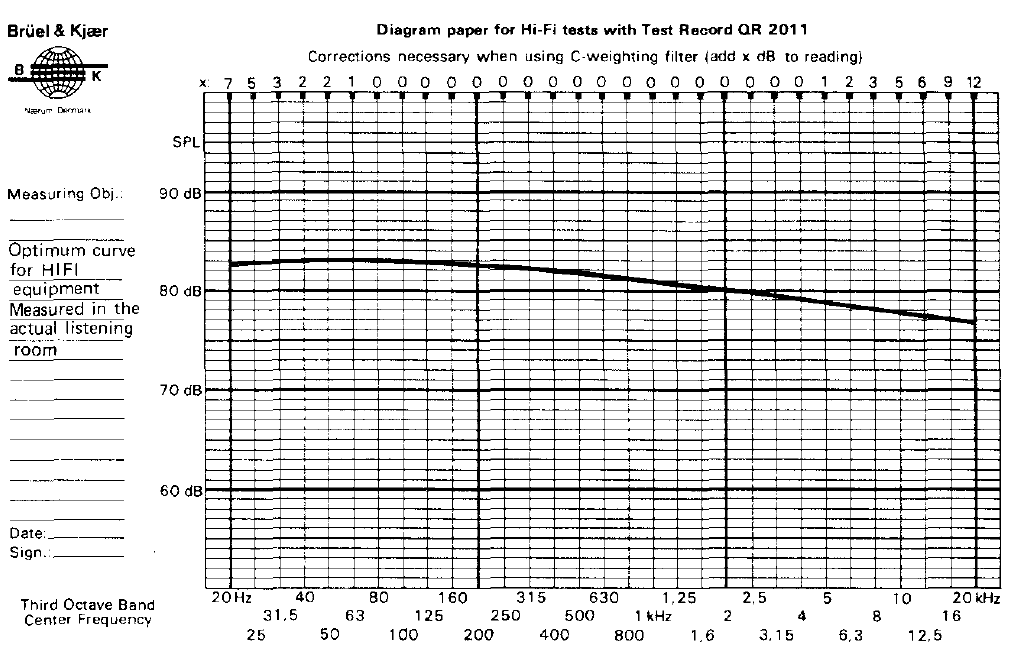
When scientists and engineers think of high-end acoustical instruments Bruel and Kjaer is among the most respected names there is. One famous bit of knowledge that has come out of that organization is the ideal B&K speaker curve, which I happen to like a lot (that's a personal preference). It is meant to be as the ideal response at the listening position. I copy it here, below:


Note that it is not flat! A speaker that measured flat at the listening location would be an ear drill. The B&K curve is about +3dB at 70 Hz or so and -3dB at 20 kHz. Quasi-anechoic measurements measure the speaker driver in near-field, with the expectation that at a distance the measurement would become like you see here. The full discussion of why this is beyond the scope of this posting, but do your research and you'll find much more written about it. You may also find that the Dirac Live target curves, also follow the B&K model of a gently descending response. The point is, I don't make this stuff up. Flat at the listening location is not actually ideal. What is ideal is open to some interpretation.  I'm choosing the B&K curves as a matter of taste.

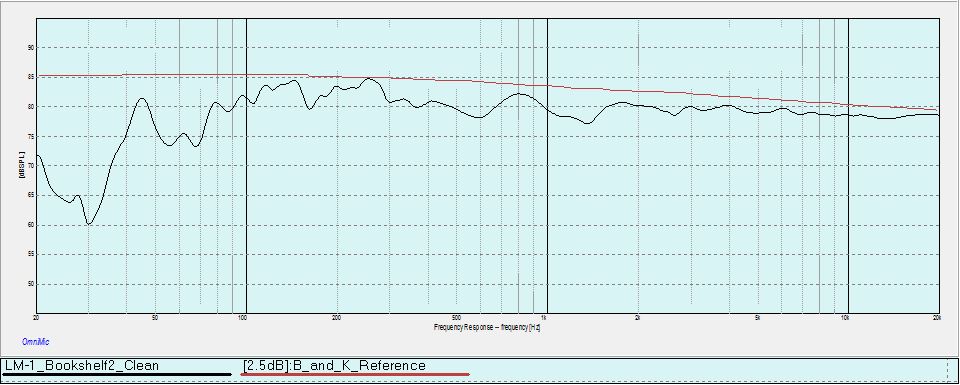
So, how does the LM-1 do by comparison to this fabled B&K curve in real life? Let's comapre (LM-1 level is offset and measured in a bookshelf):


Damn well! This is the plot with R1 = 4.2 Ohms (2.7 + 1.5 actually). I'm packing and that's all the resistors I have on hand.

So, what does this say? This is an objectively neutral speaker kit. If you are looking for a true bookshelf speaker system with reference grade frequency response the LM-1 will do it for you, within the limits of what a small monitor can do.  Also, as discussed, the treble balance is up to the builder. If you don't like it, change it. :) I have a feeling that most listeners will like a value closer to 3.9 Ohms or so.

Saturday, June 4, 2016

The LM-1 and Clarity ESA Notes

June 4, 2016

My usual go-to medium grade capacitor is Mundorf MKP, but since I had such good results with the Clarity MR caps in my reference speakers I decided to try the Clarity ESA's. 24 hours into the experience and it's still too hard.

I've increased R1 from 2.7 to 4.2 Ohms and it's much better. The LM-1 curves match the center channel curves more closely. However I'm still not quite satisfied with the treble.  Of course, this is a $35 ring radiator tweeter, vs. the $500 Mundorf AMT I've gotten used to. The two may never closely align, but I have hopes. I've heard lesser tweeters smooth out with better caps, and I've heard caps mellow out after a few days, so this may take a while before I'm ready to say I'm done.

June 5, 2016
At about 48 hours the caps got noticeably less harsh. It's also interesting to note that changing R1 from 2.7 to 4.2 made only about 1.6 dB of difference at 13 kHz, but it's all the difference in the world to my ears.

June 6, 2016
In spite of the packing going on around here, I closed some drapes and listened more last night. I'm ambivalent over the total treble balance, but the tweeter and C1 seem to have settled in quite nicely. I sometimes feel it may still be a little bright, but the measurements don't lie, I'm actually just under the B&K curve, so I'm going to leave it alone. Honestly I think my reference speakers are a little dark, so this may be a good chance for my own ears to adjust. My PC is getting packed up today, so I'll be unable to do more measurements or design as I won't have access to my only Windows 7 PC. This will be a good chance for me to explore what else is available on Ubuntu/Linux! :) 

Sunday, May 29, 2016

Somatic Response to Music

One thing I've wondered about on and off has been whether we really perceive all of what speakers make just through our ears. How much of the listening experience occurs in the body?

Now it seems an article on Salon starts to discuss this very issue.

http://www.salon.com/2016/05/29/an_orgasm_for_the_skin_partner/

Enjoy.