Conrad Johnson has the unique distinction in my mind of making not just some of the best sounding preamplifiers ever, but also the most successful lines of preamps ever. In terms of sheer volume, the Conrad Johnson line is as ubiquitous Toyota Corolla or Honda Accord.
Let me explain. We can argue about the sound quality of the Conrad Johnson Premier line, and as to whether or not brand X is better than them or not. Some detractors make good points about them being overly euphonic at times, others feel the Audio Research line sounds best for their tastes. However, when you combine the history of Conrad Johnson Premier preamps being consistently rated in the top echelons of preamps, as well as the tremendous success the PV series has had, I don't think there's another company who can claim better success. There are so many past generations of Premier and PV preamps out there that CJ could stop making new products, and still continue to pay the bills for the next 20 years with the service department alone.
So, based on this, and my own personal experience doing extensive power supply mods for my preamp, I plan to offer these mods for most of the PV line. This includes at least the PV5, PV6, PV7, PV8, PV9 and PV10 and PV11. The upgrades will involve a custom designed power supply board based on the PV12's design with upgraded, high output, high reliability regulator stage, as well as the use of modern low noise, low impedance resistors and capacitors on the board.
In the same way that Conrad Johnson designed their gain stages to be modular, the circuit board I will be installing are also modular and can be used in different ways, depending on the customer's needs and tastes. For instance, with a single board you can upgrade a PV-10 to have dual mono power supplies. With two boards, I can offer dual mono as well as double regulation. The end result is an ultra quiet power supply, and an amazingly silent performance. Another way to use them is to add a separate regulator for the phono section alone. Owners of older PV series preamps would benefit by just substituting the new module for the original altogether.
This in combination with parts upgrades on the main board can lift the performance of most PV preamps to be giant killers for a small outlay in cash. Another benefit is that because you leave the audio circuit in tact, you keep the quality of sound that you fell in love with to begin with.
More on this later, as I have to dig out the board design I used originally, and have to figure out how to charge for it. Also, I need to figure out how to get reviews. I talked to Steve at Enjoy the Music, and he pointed out that reviewers don't like to do reviews for mods, because then they would get requests from every weekend modder in the planet, so before I get a review I'll have to get famous, and I can't get famous until I get a review.... :)
Fortunately while I don't have reviews I do have a PV-10 ready for audition which has 95% of the upgrades in place already. Missing are a few resistor upgrades and replacements of the heater caps. However, you would not believe this is a PV-10 if it were not for the sweet midrange and treble. The deep natural bass and precise sound stage will knock your socks off.
But alas, the trouble at the end of the day is really who will pay for the upgrades? Is it worth it for some one to take a PV-5 and put $400 into it, when they could buy a used PV-12 for $600 on Audiogon, or a used Premier class preamp for around $1500? I don't know. It was worth it for me because I could do the labor myself.
Perhaps I will be better off selling the populated, tested power supply modules for around $75 each. Comments? Suggestions?
Sunday, February 11, 2007

Saturday, February 10, 2007
Head Phone Amplifier Upgrades
I'm pleased to offer upgrades for two very popular headphone amps, the Pro-Ject Head Box Mk II and the Rega EAR. Both amps use a high current, discrete output stage which makes them a very good, muscular platform for upgrades compared to the very popular and common IC based designs.
Why Upgrade?
Unfortunately, the reality of mass manufacturing, and sales, means that a manufacturer makes less than 30% of the sales price. This means that compromises in parts must be made in order to get the products to a price point that the target market can afford. Because of this, investing in modestly priced upgrades delivered without distributors and sales people in between can yield benefits that surpass purchasing new kilobuck hardware.
These upgrades are based on respecting the existing designs, and making them perform as well as they possibly can. Each manufacturers have made a different set of compromises. The Rega EAR screams for a quieter, more robust power supply but starts with a decent op amp. The Head Box starts with a quiet power supply, but has a really sub-par op-amp. Both amps share the need for better quality audio caps. We leave the basic design alone, but enhance the areas where each is weak, giving you the best of all worlds.
Pro-Ject Head Box Mk II
Basic upgrade:
Results:
Basic Upgrade:
Cost: $90 + Shipping
Advanced Mod (for both):
Cost:
FAQs:
Q: Why is the cost for the basic upgrade so similar for both?
A: Time vs. parts. The Head Box has more parts to replace. The EAR needs a board change to fit the necessary power supply changes, so it takes more time.
Q: Can I get Black Gate caps in the Head Box?
A: Sorry, unfortunately Black Gate caps tend to be physically large, there's only about 19mm of height available in the Head Box. The values that are needed for critical caps like the power supply and coupling caps that are needed are just too tall.
Q: What does the Black Gate upgrade do?
A: Honestly I've never listened to BG's in either of these devices, but there's always some one who wants them in, so yes, it can be done. This would be especially important in the coupling caps. One reasons why I don't usually like to use BG's is that they like to charged for days before sounding good, and I hate wasting electricity. However, the power draw of these amps is so small at idle, this is not an issue.
Q: Is the upgraded Head Box really better than the stock Rega EAR?
A: Clearly. The Head Box starts off weak in the bass, especially with low impedance headphones like the newest Grados. The basic upgrade makes the bass as good as the EAR while surpassing it on the midrange dynamics.
Q: What's the end result of both modified the same way?
A: Honestly, I'm afraid to say that the end result is very similar. Once the basic level is reached, they are very similar in performance. Unfortunately this also means that, in my opinion, if you are starting from scratch your best value is a modified Head Box. On the other hand, if you already bought an EAR and like it, you will be missing out on just how good this amp can be if you don't upgrade it.
Q: Is the Advanced Upgrade really worth it?
A: Yes, completely. When I do the advanced upgrade I socket the op-amps. If you want you can go back and forth between the upgrades I provide and the originals. Request this in advance please so I don't throw the originals out. (Head box op-amps are super cheap, and hard to pull out in one piece though, you may end up with an NE5532 instead of the original, but I promise, it's better than what you had).
Q: Can I get just the Advanced Upgrade?
A: Yes, but...why would you? The stock Head Box won't give you enough bass to drive your high output cans, and the stock Rega EAR won't be quiet enough. Upgrading the op-amp will just make it easier for you to hear how noisy the stock supply is.
Q: Will this void the factory warranty?
A: Yes. However, fixing a future problem with either of them should be a piece of cake. Chances are if anything goes wrong it will be the with the op-amps. The advanced upgrade sockets all of them, so replacing them is a matter of minutes.
Q: Do you offer a warranty?
A: Yes, 90 days parts and labor on parts I actually replace. If both op-amps go however, I'll charge for their replacement, as this tends to only happen after an electrical surge. Also, the Head Box is a very tight tight squeeze for the upgrade parts. If you decide to open it up to look and break off a capacitor, I will charge you for parts and labor. If you are the kind of person who is like that, let me know and I'll ship it to you out of the case, or send you pictures of the upgrade first. :)
Q: Do you have a sample I can listen to?
A: Yes. I have an upgraded Head Box you can listen to if you are in the Boston area.
Q: Do you sell "new upgraded" Head Boxes?
A: Yes, I can source them new. For these I offer 90 Days parts and labor on all parts. Saves you the cost of shipping one to me, but if you can buy one used or at a discount, you can get a better deal.
Q: Can I listen to the upgrade and return it if I don't like it?
A: Honestly I don't like doing this as a lot of people like to reverse engineer a great set of upgrades. If you don't believe the advanced upgrade is worth it, I'll exchange the op-amps and parts for $30.
Why Upgrade?
Unfortunately, the reality of mass manufacturing, and sales, means that a manufacturer makes less than 30% of the sales price. This means that compromises in parts must be made in order to get the products to a price point that the target market can afford. Because of this, investing in modestly priced upgrades delivered without distributors and sales people in between can yield benefits that surpass purchasing new kilobuck hardware.
These upgrades are based on respecting the existing designs, and making them perform as well as they possibly can. Each manufacturers have made a different set of compromises. The Rega EAR screams for a quieter, more robust power supply but starts with a decent op amp. The Head Box starts with a quiet power supply, but has a really sub-par op-amp. Both amps share the need for better quality audio caps. We leave the basic design alone, but enhance the areas where each is weak, giving you the best of all worlds.
Pro-Ject Head Box Mk II
Basic upgrade:
- Replace all electrolytic capacitors with very high quality, low impedance versions
- Improve reliability with upgraded specs on critical power supply caps
- Socket Op-amp with gold dipped machined low profile socket
- Replace Op-amp with same type as used in the stock Rega EAR
Results:
- Much better midrange and treble
- Bass opens up completely
- Low impedance headphones no longer have severely restricted bass
- Performance exceeds stock Rega EAR in many ways, including lower noise, sweeter midrange through clear effortless treble, and an open easy breathing bass.
Basic Upgrade:
- Replace most electrolytic caps with very high quality, low impedance versions (Black Gates by request, for an additional fee)
- Modify power supply for lowest possible noise, and gutsier performance. This includes a mod to the circuit design as well as adding parts.
- Add by-pass caps on outputs (subject to space limitations)
- Noise greatly reduced, especially hum
- Greatly increased clarity
- Better midrange through treble, more natural, less restrained.
- Slightly gutsier bass
Cost: $90 + Shipping
Advanced Mod (for both):
- Socket op-amp with machined, gold dipped low-profile socket.
- Replace op-amp with Burr Brown OPA 627s, considered by many to be among the finest available. At $50 per pair, they are certainly among the most expensive!
- Replace critical power supply resistors with ultra-quiet, Vishay MIL-SPEC metal film versions
- For Head Box only, replace ceramic disk caps to fit adapter
- Unbelievably natural and smooth transients and decay. This applies especially to listening to instruments as well as cues about the room space.
- Treble and midrange appear to be effortless, and unrestrained. You loose the sense of listening to headphones.
Cost:
- Basic + Advanced Upgrade: $150 if done at once.
- Advanced Upgrade: $95 if done after basic
FAQs:
Q: Why is the cost for the basic upgrade so similar for both?
A: Time vs. parts. The Head Box has more parts to replace. The EAR needs a board change to fit the necessary power supply changes, so it takes more time.
Q: Can I get Black Gate caps in the Head Box?
A: Sorry, unfortunately Black Gate caps tend to be physically large, there's only about 19mm of height available in the Head Box. The values that are needed for critical caps like the power supply and coupling caps that are needed are just too tall.
Q: What does the Black Gate upgrade do?
A: Honestly I've never listened to BG's in either of these devices, but there's always some one who wants them in, so yes, it can be done. This would be especially important in the coupling caps. One reasons why I don't usually like to use BG's is that they like to charged for days before sounding good, and I hate wasting electricity. However, the power draw of these amps is so small at idle, this is not an issue.
Q: Is the upgraded Head Box really better than the stock Rega EAR?
A: Clearly. The Head Box starts off weak in the bass, especially with low impedance headphones like the newest Grados. The basic upgrade makes the bass as good as the EAR while surpassing it on the midrange dynamics.
Q: What's the end result of both modified the same way?
A: Honestly, I'm afraid to say that the end result is very similar. Once the basic level is reached, they are very similar in performance. Unfortunately this also means that, in my opinion, if you are starting from scratch your best value is a modified Head Box. On the other hand, if you already bought an EAR and like it, you will be missing out on just how good this amp can be if you don't upgrade it.
Q: Is the Advanced Upgrade really worth it?
A: Yes, completely. When I do the advanced upgrade I socket the op-amps. If you want you can go back and forth between the upgrades I provide and the originals. Request this in advance please so I don't throw the originals out. (Head box op-amps are super cheap, and hard to pull out in one piece though, you may end up with an NE5532 instead of the original, but I promise, it's better than what you had).
Q: Can I get just the Advanced Upgrade?
A: Yes, but...why would you? The stock Head Box won't give you enough bass to drive your high output cans, and the stock Rega EAR won't be quiet enough. Upgrading the op-amp will just make it easier for you to hear how noisy the stock supply is.
Q: Will this void the factory warranty?
A: Yes. However, fixing a future problem with either of them should be a piece of cake. Chances are if anything goes wrong it will be the with the op-amps. The advanced upgrade sockets all of them, so replacing them is a matter of minutes.
Q: Do you offer a warranty?
A: Yes, 90 days parts and labor on parts I actually replace. If both op-amps go however, I'll charge for their replacement, as this tends to only happen after an electrical surge. Also, the Head Box is a very tight tight squeeze for the upgrade parts. If you decide to open it up to look and break off a capacitor, I will charge you for parts and labor. If you are the kind of person who is like that, let me know and I'll ship it to you out of the case, or send you pictures of the upgrade first. :)
Q: Do you have a sample I can listen to?
A: Yes. I have an upgraded Head Box you can listen to if you are in the Boston area.
Q: Do you sell "new upgraded" Head Boxes?
A: Yes, I can source them new. For these I offer 90 Days parts and labor on all parts. Saves you the cost of shipping one to me, but if you can buy one used or at a discount, you can get a better deal.
Q: Can I listen to the upgrade and return it if I don't like it?
A: Honestly I don't like doing this as a lot of people like to reverse engineer a great set of upgrades. If you don't believe the advanced upgrade is worth it, I'll exchange the op-amps and parts for $30.
Monday, February 5, 2007
Tandberg Upgrade Board Pics
For some reason Audiogon is having trouble processing my pictures, so if you are here to look for more information about the Tandberg 3001/A upgrade board, some pics should be here:
Connector Beauty Shots
Connector Beauty Shots
Saturday, January 20, 2007
The Upgraded Pro-Ject Head Box Mk II
This morning the Pro-Ject underwent a major upgrade. All the electrolytic caps were replaced with Panasonic FM Caps, and the op-amp was socketed and replaced with an NE5532.
First impressions are WOW! :) The treble response is a lot better, the midrange has opened up and sounds absolutely spacious with deep bass, and a very extended treble. The Head Box Mk II plus this upgrade is highly recommended.
There were a few changes from the standard values which were made, here is what you need to do to replicate:
The one problem is that it's picking up all the noise coming from my PC, which it masked before. I guess the next step is going to be an outboard DAC for it. :)
One tip, make sure you put the 1,000uF caps as close to the board as you possibly can. It's going to be a tight squeeze.
First impressions are WOW! :) The treble response is a lot better, the midrange has opened up and sounds absolutely spacious with deep bass, and a very extended treble. The Head Box Mk II plus this upgrade is highly recommended.
There were a few changes from the standard values which were made, here is what you need to do to replicate:
- 1000uF caps were upgraded from 16V to 25V. This is more of a longevity issue than sound.
- Input caps C13, 14, 16 and 17 were upgraded from 4.7uF to 22uF. For two reasons. First, they are almost the smallest FM caps I could find. Second, I wanted to beef up the bass response.
- Output caps C8 and C10 were upgraded from 470uF to 1,000uF. Again, to improve the bass response at the headphones.
- Op-Amp replaced with an NE5532. I know I dissed it as old, but it was a good old op-amp and I have them lying around.
The one problem is that it's picking up all the noise coming from my PC, which it masked before. I guess the next step is going to be an outboard DAC for it. :)
One tip, make sure you put the 1,000uF caps as close to the board as you possibly can. It's going to be a tight squeeze.
Sunday, January 14, 2007
Upgrading the Suzuki
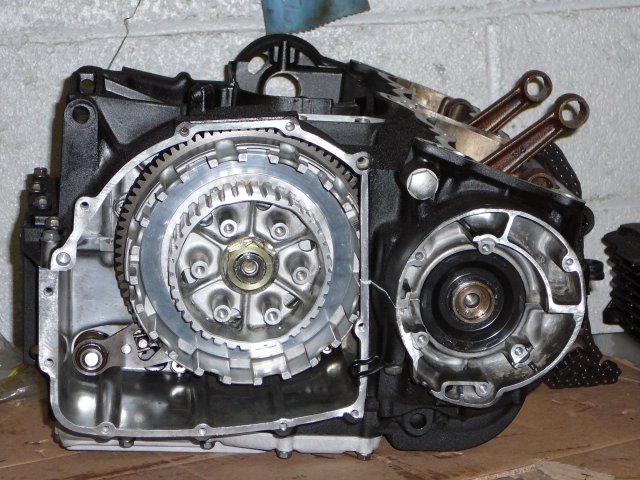
Well, in this case I'm actually downgrading it. At some point around 1989 I acquired a 1978 Yoshimura modified Suzuki GS 1000. It was actually nearly impossible to ride on the street. So I'm having Bikeworx rebuild the engine, repaint it and the frame, and add all the silly things that the DMV requires such as turn signals, horns, that sort of safety nonsense. So for those of you who care, here is a pic of the bottom half of the engine and transmission. With a little luck, when I'm not soldering uber expensive op-amps into inexpensive gear I'll be riding this. 


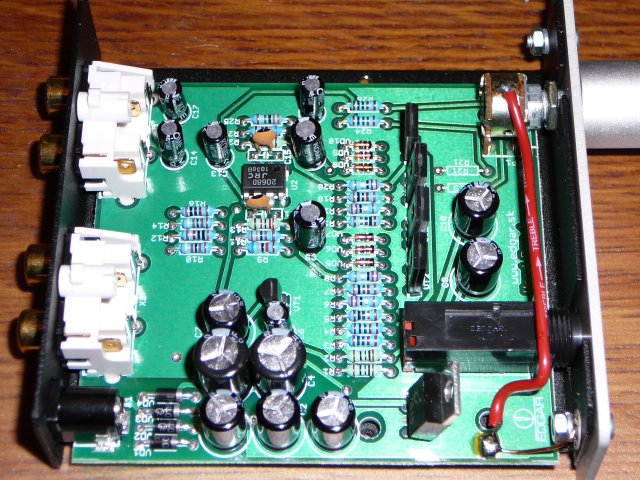
Inside the Pro-Ject Headphone Amplifier
It's only fair that if I show you the insides of the Rega EAR I also show you the insides of the  Pro-Ject Mk II. Keep in mind that while the Pro-Ject has more parts in it than the Rega, it's case is half the size. Most of the Rega's ingides is air.
Something I forgot to mention in my last post is that another way in which the build of the Head Box is superior to the EAR is that it uses a double sided board with massive ground and power planes. This means less noise, lower power supply impedance. It also allows the board designer to run direct, short traces from one section to another.
It's clear from looking at the design that the designer worked very hard to keep the audio signal paths optimized, and any radiated EMI from the power supply away from them as much as possible. This is why the power supply caps are crammed in the way they are, and also why there's a mix of 470uF 25V caps and 1,000 uF 16V in there as well. The latter I'm a little worried about, because they are filtering the 15V supply, which gives the caps only about 1V margin of error before they are rated to break down rapidly. A pair of 25 Volt caps would make me feel better about the durability of them. I'll see if I can find some miniatures that will fit.
 Pro-Ject Mk II. Keep in mind that while the Pro-Ject has more parts in it than the Rega, it's case is half the size. Most of the Rega's ingides is air.
Something I forgot to mention in my last post is that another way in which the build of the Head Box is superior to the EAR is that it uses a double sided board with massive ground and power planes. This means less noise, lower power supply impedance. It also allows the board designer to run direct, short traces from one section to another.
It's clear from looking at the design that the designer worked very hard to keep the audio signal paths optimized, and any radiated EMI from the power supply away from them as much as possible. This is why the power supply caps are crammed in the way they are, and also why there's a mix of 470uF 25V caps and 1,000 uF 16V in there as well. The latter I'm a little worried about, because they are filtering the 15V supply, which gives the caps only about 1V margin of error before they are rated to break down rapidly. A pair of 25 Volt caps would make me feel better about the durability of them. I'll see if I can find some miniatures that will fit.
Saturday, January 13, 2007
The Pro-Ject Headphone Amplifier
I'm still looking for good values in headphone amplifiers. As you might recall, I previosly tried the Rega EAR, which was just too expensive and offered too little, and was noisy, so I started looking for something cheap enough that I could leave at work, and maybe give me equal or better value, and maybe be worth modding a little hear and there.
I think I've found it in the Pro-Ject Head Box MKII. The Pro-Ject headphone amplifier has a similar design to the Rega. Meaning, single ended supply, one op-amp driving a discrete amplifier stage. Externally there are two major differences. The price, $99 for the Pro-Ject vs. $299 for the EAR as well as the complete lack of switches on the Head Box. Which I guess makes sense if you are going to put in some BlackGate capacitors that means you'll have to leave the box on all the time anyway. :)
Listening Tests
Right out of the box, the Head Box is significantly quieter than the Rega EAR. I can hear no noise at all except at the loudest setting. It seems to be a little weak on the bass however, and perhaps a little on the treble as well.
Build Quality
The Pro-Ject headphone amp is less expensive than the EAR, but better made, in my opinion. This major difference probably has to do with the power supply filtering. The EAR had about 1,500 uF of filtration, the Head Box around 4,000, with a significant amount of filtration occuring after the voltage regulator.
Just like the EAR, the Pro-Ject amp has to have capacitors at the outputs. They are about half the size of the EAR's so this may account for why I feel the bass just isn't making it all the way through to the headphones.
Future Mods
There are two major areas where you can improve this little box. First is in the capacitors. Replace them all with Panasonic FM's. For the output caps, replace them with 1,000uFs if possible. This should get you some more oomf.
The other area is in the op-amp. There's nothing wrong with the original, but there is nothing great about it either. Socket it and experiment. If you can find an NE5535 to hear what vintage class-A op amps sounded like, I'd recommend it. :)
I'll post as I apply the mods.
I think I've found it in the Pro-Ject Head Box MKII. The Pro-Ject headphone amplifier has a similar design to the Rega. Meaning, single ended supply, one op-amp driving a discrete amplifier stage. Externally there are two major differences. The price, $99 for the Pro-Ject vs. $299 for the EAR as well as the complete lack of switches on the Head Box. Which I guess makes sense if you are going to put in some BlackGate capacitors that means you'll have to leave the box on all the time anyway. :)
Listening Tests
Right out of the box, the Head Box is significantly quieter than the Rega EAR. I can hear no noise at all except at the loudest setting. It seems to be a little weak on the bass however, and perhaps a little on the treble as well.
Build Quality
The Pro-Ject headphone amp is less expensive than the EAR, but better made, in my opinion. This major difference probably has to do with the power supply filtering. The EAR had about 1,500 uF of filtration, the Head Box around 4,000, with a significant amount of filtration occuring after the voltage regulator.
Just like the EAR, the Pro-Ject amp has to have capacitors at the outputs. They are about half the size of the EAR's so this may account for why I feel the bass just isn't making it all the way through to the headphones.
Future Mods
There are two major areas where you can improve this little box. First is in the capacitors. Replace them all with Panasonic FM's. For the output caps, replace them with 1,000uFs if possible. This should get you some more oomf.
The other area is in the op-amp. There's nothing wrong with the original, but there is nothing great about it either. Socket it and experiment. If you can find an NE5535 to hear what vintage class-A op amps sounded like, I'd recommend it. :)
I'll post as I apply the mods.
Subscribe to:
Posts (Atom)