Thursday, November 23, 2006

Rega EAR Headphone Amplifier, Final Analysis

After taking a close look at the insides (see previous post) and listening to the Rega EAR headphone amplifier for about 3 hours I can finally give you my reader my definitive take on the product.

I tried four different pairs of headphones:

  • AKG K 701
  • AKG K 240 Studio
  • Shure E4C
  • Sony MDR-V600

and 2 different source components. I compared the EAR to my SUMO Athena non-headphone enabled preamp, as well as to the direct outputs of my Creative Labs Jukebox Zen 2.0. I actually chose the Athena because I knew that it had limited low impedance drive capability. I figured that it would emulate what a poorly designed headphone jack would do to the sound. On the plus side, it's pure class A and has about a 600 Ohm output impedance, which is pretty darn low for a line level amplifier. Still, it should have been blown away by the EAR.

After a few hours of listening, and after looking closely at the insides I can't recommend this product. Either in absolute terms or price / performance wise.

Compared to the Sumo Athena, it adds too little. The only times I could tell it was a better driver for the headphones was with the 29 Ohm E4C's. Compared to the direct outs, it seemed to muddle the sounds and rob bass drums of their midrange strike and impact. With the AKG 701s it seems to get harsh when there are complicated passages with a lot of upper midrange. Overall, it's a noisy piece of gear, which makes sense given the limited filtering done in the power supply. You can't turn it up too much before the hum of the power supply is clearly evident. The Sony MDR-V600s made the noise problem even worse. They are the most sensitive headphones I have and have a lot more treble than the AKGs which made the hiss from the Rega almost unberaable.

My sample even has some weird oscilation going on when you turned the volume up just a bit, which would disapear, but come on, guys. It's not like you don't have anyone in England who can show you how to design a current amplifier stage that won't oscillate. Otherwise I found the sound to be a complete "Why bother?"

My suggestion to would be amp buyers is to give this one a pass, or buy one, then sell the plastic Rega label on the front so you can go through it top to bottom and mod it until it shines. If. Well, never mind. Don't buy it.

Wednesday, November 22, 2006

The Rega EAR Gutted!

Last weekend after finishing a mid-term early, I decided to reward myself with a new headphone amplifier. I'd been using this as my primary listening station:
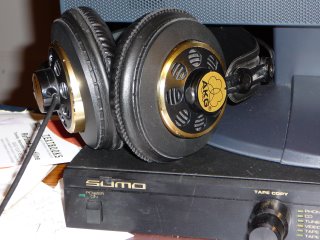


What you see are a pair of AKG K240 600 Ohm headphones. Why 600 Ohms? Because I'm driving them directly from the James Bonjiorno designed SUMO Athena preamp. It's a Class A design with tremendously low output impedance. Certainly low enough to drive these headphones, but it does get noisy if I turn up the gain as much as I need to.

I wanted a headphone amp so I could get gain and power, and free up some desk space. The Rega EAR is less than half the width of my preamp, and fits nicely in a cubby in the desk.

After getting the EAR home, the first thing I did, which was probably a mistake, was take it apart so I could look at the guts. In large part because no magazine review I'd seen had shown us the insides. And now I know why. Tis a sad thing indeed. I am hesitant to even show you but since I know thats why you come here, I'll give you the full naked view first:

From what I can see, you could make something better with about $40 worth of parts. $45 if you include the wall wart. Throw in another $40 and you could have top quality jacks.

The inadequacies with the price/value of this product begin in the power supply. It is single ended power supply, with a single voltage regulator. Remember this, because this is going to cause us problems in the audio section design, which we will cover later.

All of the electrolytic caps are standard grade Korean made Samwha capacitors. By the way, nothing wrong with Korean products. Especially their shoes! My complaint is that they are very standard grade parts, and that by using the simplest possible power supply design you end up having to route your output signal through capacitors before feeding your cans.

Another sad parts about this product is the single input buffer and possibly voltage gain stage. Rega chose to use a single op amp, the NE5532. It's a fine Op Amp. Phillips used to put them in their top of the line CD players, circa 1989. Come on fellows, it's 2006, almost 2007. Would it have killed you to at least use the class A biased NE5535 instead, or any of the superior Burr Brown or Analog Devices products out there today? And how about two of them so you minimize the crosstalk between them?

The one bit of good news is the discrete output stage. Unfortunately whatever good this does for us is undone by the power supply. Because it's a single ended supply, this means that there must be output capacitors. And there are. Two big electrolytics, which are NOT bypassed. That's right. No bypassing. Just straight through. Are they kidding me? No, seriously, an NE5532 and tin can electrolytic output caps? Are they bleeping kidding me?

The last problem I had was that the circuit board is single sided. There's nothing wrong with this, in general, but when you use a single sided circuit board you end up sacrificing the cleanness of the copper layout in order to save a few bucks in the board manufacture. This tends to affect the critical ground and power planes the most. Also, this is a dirt cheap thing to change.

If you can get this thing cheap, it may be a good started uprgrade project for some one. Rip out the electrolytics and replace them all with Panasonic FM. Bypass the output caps, and socket the Op Amp so you can experiment with a variety of op amps.


I did get a chance to audition the Rega EAR at the store with an AKG 701, and compare it to a pair of 600 Ohm AKG 240s. In my opinion, the AKG 701's started to sound compressed and tired when music got complicated and loud.

Over the rest of the week I'll start actually listening to this thing in my system. And maybe after that I'll start discussing the upgrades. But seriously, it's almost a sad thing to NOT upgrade this thing.

Based purely on the parts they put into this product, I have to say, you are better off saving your money and getting something like the HeadRoom Micro Amp for $299. It has seriously better parts value than this... throw back to the days of early mass market Japanese components.

Sorry Rega, I think that this is an exorbitant amount of money to charge people for what you are giving them. Get rid of the extruded aluminum exterior, and take the money you'd save on it and put it towards some decent grade components.

By this Thanksgiving weekend I'll have my actual listening tests concluded and will publish the results.

Sunday, November 19, 2006

Coming up Next: The Rega EAR

Gentle Reader,

I have purchased a Rega EAR headphone amplifier for use in my ever evolving home office system. It's gotten great reviews among the head can users plus I got it at a steep discount for being sitting too long as the demo unit at a local headphone store. Don't let that fool you though, most of the other one's disapeared quickly.

Over the next few days I'll be evaluating it against my reference standard headphone amp, a vintage Sumo Athena, as well as the direct outputs of my Creative Zen 2.0 driving my AKG 240 600 Ohm cans as well as the Shure E4C's.

I have to tell you, construction wise, I think it's very little product for the money. $299 new is a lot of change to put down on a circuit board with so few parts, that uses an off the shelf wall wart as it's primary supply. I'll be posting pictures of the insides, and recommended upgrades as I go along, if I think it's worth it.

Cheers!

Sunday, November 12, 2006

Man, Just how many Transistors Can you Replace?

It's been hard going here folks. The 25V supply is not showing me any love, but I am getting closer. The most likely problem I'm having is the darlington arrangement. The T0-92 which drives the TO-220 shorted, and at some point the brand new 6.8V zener I put in also smoked.

I have found upgrades for most of the NPN and PNP transistors used, usually just an improvement in the voltage rating. This may not sound like anything useful, but actually, since I don't have a load on the power supply, the voltage after the bridge rectifiers is unusually hot. Higher voltage transistors, and a higher wattage zener will help me keep the thing alive longer until I can put it back into the tuner.

After this, it's back to the 5V supply. Which is basically where I was a month ago. :))

Saturday, November 11, 2006

Beware the Lurkers!

One thing I've come to find out about you, dear readers, is that when my blog posts positive things, I get a lot of requests for more information, maybe even some custom mods. But when I post that I've just smoked a resistor, people who were previously sending me e-mails suddenly pretend they don't know me.

So from now on, it's nothing but good stories! About how wonderful the tuner sounds now that I've modded it, and how incredibly sexy the insides and outsides look, and how the mods I have made to my Conrad Johnson PV-10/Erik surpass all tube preamps, ever. All lies, of course, since the tuner isn't even working, and the PV-Erik sounds good, but not better than the good folks at CJ do on their better days, but come on, what do you want? Endless florid reviews that amazingly all say that every single piece of equipment I listen to is priced exactly what it is worth? Don't you get enough of that from the audiophile rags? Well, OK then, I can write like that too, and from now on, I will.

Psych!! Haha! This is not one of those sites I'm afraid. This blog is for the Solder Slapping Adventurer! The Geek who wields his iron like a light saber, striking fear into the hearts of tweak peddlers, gullible consumers, and sometimes our own children and spouses. We are not made of fearful stuff, for we are warriors and we undestand that the feeling of a 500V capacitor discharging through our fingers then down the left side of our rib cage to grab the pericardium so hard we can feel it's entire circumference around our hearts is to be knighted by Thor himself! Now raise your temperature controlled soldering iron into the heart of the storm above your heads, into the toxic fumes of evaporated rosin and scream your defiant battle cry:

Mod-it!

Mod-IT!!

MOD-IT!!!

Sunday, November 5, 2006

NPN's, aren't they all the same???

Well, kind of sort of. :) I think I found a temporary solution to my blown transistors issue, an MPS A42 which thank goodness does not have a center collector. It's also a 300V part, but what the heck, I'll take whatever I can. The gain is close to the originals.

This may all be moot, as I have wasted most of the weekend and haven't really studied. I really wanted to listen to my tuner before the end of the week. Guess it will have to wait.

Saturday, November 4, 2006

Honey, what's that smell?

"Um, nothing dear.........."

I replied, pulling the power cord on the power supply I was trying to revive.

I had the power supply 90% operational, the only thing I was having issues with was too little on the 5V supply. So, I was re-checking the the voltages using little pieces of wire in the Molex jacks, when I accidentally shorted the 25V supply go ground. Urgh!! !


That smell which wasn't really there was the bouquet of a young 5 watt Mills resister starting to melt it's protective cover.

Now, the PS is 30% operational. I have 15V, but no 25V or 5V coming out of this thing. I could probably get it working again with some generic replacements, but for some reason I don't have a single NPN transistor in a TO-92 case in the house. I guess it's time to order from Mouser again, and I might as well order more power resistors from Parts Exchange, if I'm going to be smoking what I have.

I can't find a source for the BD 419. I can find close matches, but most of the modern replacements have a center collector, which make them hard to retrofit. At this point I feel lucky just to have found the general specs for it. In case anyone can help find a replacment I am looking for:


  • Pins: EBC
  • Power: 2W
  • Hfe: 60
  • Vce 100
  • Through hole, so TO-220 or TO-202

On the other hand this may be a sign from Eutectic, the God of Solder, to design a new power supply board. I may very well end up with the single most expensive Tandberg 3001 ever. :)

More later!